
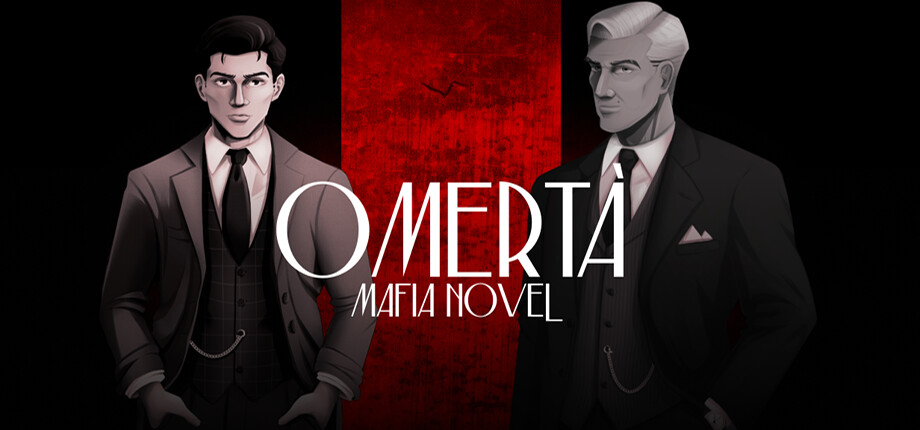
Today, we’re stepping into unfamiliar territory. Omertà: Mafia Novel from Bizi Games takes a different approach to storytelling, giving players the opportunity to shape the direction of a novel through their own decisions. But can this unusual blend of reading and gaming actually work? Is “playing” a novel better than reading one?
A story of crime, family and questionable decisions
We find ourselves in 1950s New York. Neon lights, a distinctly noir atmosphere and men in seemingly expensive suits running the neighbourhoods. We follow Alessandro Vieri, a young Italian immigrant whose family moves to America in search of a better life. Following his father’s death and his mother’s declining health, Alessandro decides to make something of himself. As fate would have it, his path eventually leads him into the world of organised crime.

The prologue feels a little rushed. It’s almost as if the developers thought, “I know I need to tell you the backstory, but I can’t wait to show you what the main act has to offer.” And I can understand why. The main story is where things become more intriguing and where the narrative finally finds its rhythm.
The transition into prison could certainly have used a little more explanation. After witnessing something he probably shouldn’t have, Alessandro suddenly finds himself being asked by the Don how he’d like to end up behind bars. You get a handful of options, all of which lead to the same destination. Apparently, when the Don offers you a choice of how you’re going to prison, refusing isn’t really on the table. An offer you cannot refuse, quite literally.

Once the main story gets going, however, I found myself much more invested. This is also where your choices start to have a greater impact on how events unfold. Before long, I found myself wondering what was going to happen next.
Your choices, your story
You’ll be presented with plenty of choices throughout the experience. Some carry significant consequences for the story, while others have relatively little impact on how things unfold. I was pleasantly surprised by just how differently certain decisions could steer the narrative.

With multiple story branches and endings to discover, there’s an incentive to return and see how things might have turned out had you made different decisions. You won’t always know whether a choice is important when you make it, and sometimes its consequences only become apparent much later.
My first playthrough took approximately an hour and a half. It’s not a particularly lengthy experience, but the different paths and endings give you a reason to revisit the story.
Bringing the story to life
The story is brought to life through illustrated locations and characters, all presented in a distinctive 2D noir style. Overall, the artwork looks fantastic, with the characters and environments helping to bring the narrative to life. Some locations look better than others, but the visual presentation does a good job of helping you picture the world you’re reading about.

I did encounter a visual bug where Alessandro appeared wearing clothing belonging to a much later part of the story. It’s a relatively small issue, but one that can interrupt the experience and potentially reveal something a little earlier than intended.
The audio adds another layer to the experience, with sound effects and background jazz helping to establish the atmosphere. The music works well for the most part, although there are moments when the jazz feels slightly out of place.
One thing I did find disappointing, however, was the complete lack of voice acting. With so much dialogue to read, hearing the characters brought to life would have made a significant difference. I appreciate that Omertà comes from a two-person development studio, but I still feel this is an area where the experience could have benefited considerably.
So, is playing a novel better than reading one?
Unfortunately, the answer isn’t quite that straightforward.
Omertà: Mafia Novel won’t appeal to everyone. If you’re expecting traditional gameplay, action or plenty of interaction beyond making decisions, you might find the experience a little limited. However, if you enjoy the idea of reading a story where you get to influence how events unfold, there’s something genuinely enjoyable here.
Despite my criticisms about the rushed prologue and the lack of voice acting, I enjoyed following Alessandro’s story, exploring different choices and discovering where they would lead. The artwork and atmospheric audio help bring the world to life, while the multiple endings give you a reason to return and see how differently things could have turned out.
Omertà certainly made me reconsider what an interactive novel can offer, even if it didn’t convince me that playing a book is necessarily better than reading one.
IS IT WORTH LOSING SLEEP FOR?
🛏️ 🛏️ 🛏️ 🛏️ 🛏️
3/5
A decent late-night distraction.
Leave a Reply