
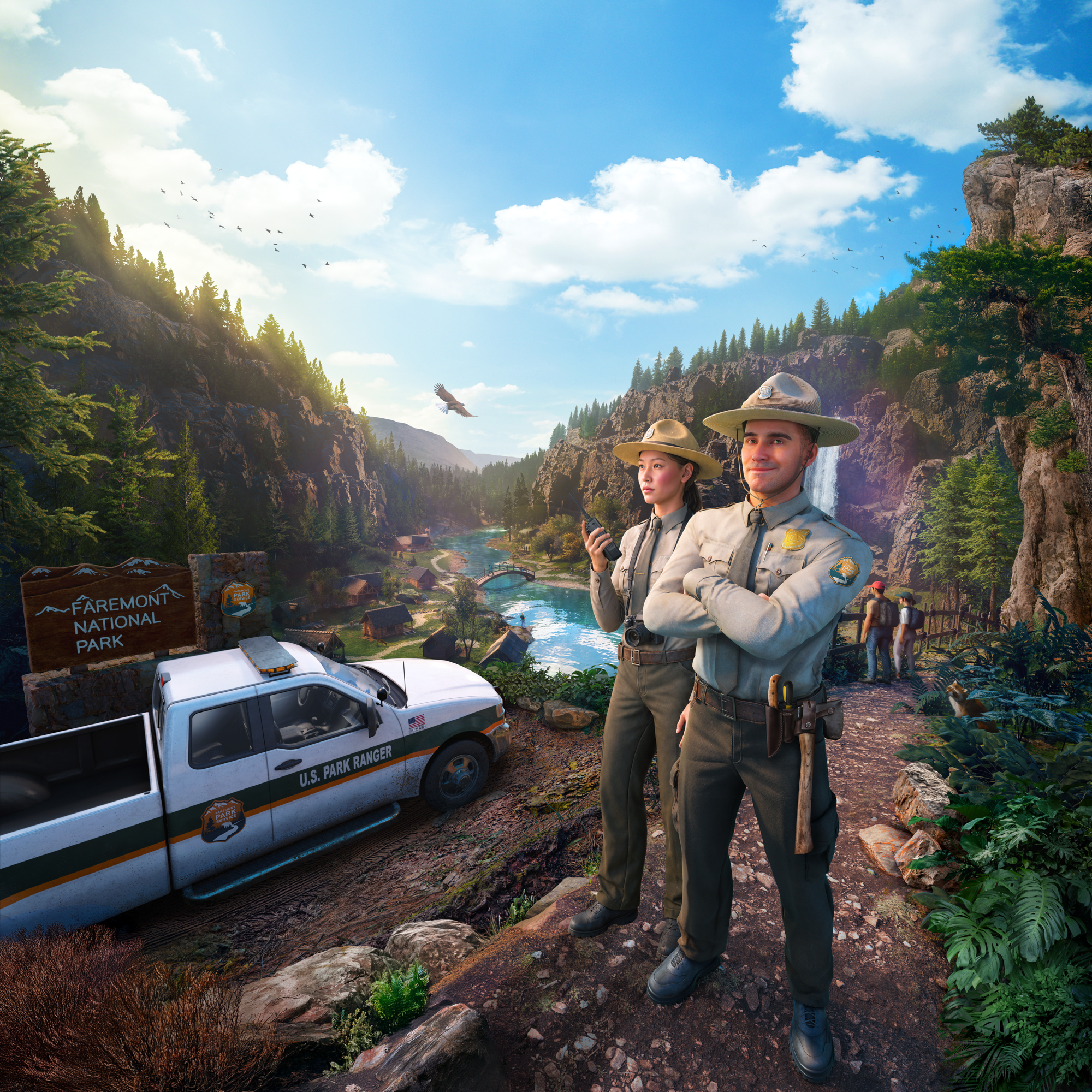
The simulator genre is booming right now, with games covering everything from everyday activities like mowing the lawn to more complicated tasks like flying an aeroplane. This week, Ranger’s Path: National Park Simulator has landed on our desk. We’re taking the next couple of nights off from playing GTA VI to see where this latest release sits on the simulator scale. Can it deliver an enjoyable park ranger experience, or will we spend more time fighting the game than enjoying the great outdoors? And, most importantly, can we find Yogi the Bear?
Welcome to Faremont National Park
Our adventure begins in the fictional Faremont National Park, where we’re about to start our first day as a park ranger. Before getting stuck into our daily duties, we’re asked to create our character. The options are very limited, with just three preset appearances to choose from for each gender and no further customisation available.
We cannot open the park until we’ve walked the paths and made sure everything is in tip-top shape. It quickly becomes clear that the park is not in great condition. From knocked-over trail markers and vandalised benches to areas filled with rubbish, fallen trees and overgrown paths, the to-do list seems never-ending.

More Handyman Than Park Ranger
This is where the game starts to feel more like a job than a game. Our ranger carries a variety of tools to help with the tasks at hand. A hammer, screwdriver, paint gun, axe, saw and litter picker are just some of the tools available in our arsenal.
All repairs are carried out through mini-games, and these become repetitive rather quickly. Whether it’s pressing the trigger at a specific moment, moving the thumbstick back and forth or repeatedly pressing one button to collect rubbish, you’ll be performing these actions quite a lot. Each area of the park has a substantial amount of damage, so you’ll find yourself repeating the same tasks over and over. And guess what? Even after you’ve finished, things like severe weather and vandals can undo much of your hard work, leaving you with even more repairs to complete. At times, it feels like you’re a handyman more than anything else.

Keeping an Eye on the Visitors
Away from our handyman duties, we also have some authority over the park’s visitors. This involves keeping an eye out for suspicious behaviour and checking permits. The process is fairly straightforward: you approach visitors, ask them to provide their permit and decide whether they’re allowed to be there. You can then choose to give them a warning or kick them out of the park altogether. Outside of the tutorial or specific missions that required it, I haven’t really used this feature much. I was simply too busy running around fixing everything.
The NPCs roaming the park serve more as a backdrop than anything else. They have very little personality, greet you with repetitive lines and will often read broken signs as if they’re already fixed. It doesn’t exactly make the park feel particularly alive.
A Walking Simulator with Chores
The park itself is quite large, so you’ll be travelling around a lot. Vehicles are available, and while they feel a little arcadey, they’re certainly better than walking everywhere. However, with limited roads throughout the park, you’ll still spend a considerable amount of time on foot. Before long, the game starts to feel like a walking simulator with chores.
Thankfully, there is a levelling system to help make things a little easier. Almost every successful action in the park rewards you with XP, which helps level up your character. As you progress, you’ll unlock fast travel between locations, additional vehicles and improvements that make the mini-games quicker. For example, you eventually won’t need to hit a plank with the hammer three times, as two hits will do the job. These upgrades are useful, although getting to them takes time.
Missions, Call-outs and Photography
The game also gives you a series of missions that encourage you to explore the entire park. These are quite enjoyable and offer a bit of variety, with objectives ranging from repairing different areas of the park and searching for lost visitors to finding animals, catching poachers and dealing with vandals. However, between missions, you can sometimes find yourself without much to do. Rather than giving you another objective, the game simply tells you that you need to earn more XP before you can progress.
Outside of the main missions, you’ll also receive call-outs, which are smaller tasks that you can either accept or decline. The problem isn’t necessarily the call-outs themselves, but how frequently they appear. You could be in the middle of an important mission and receive seven or eight different requests, even after refusing them all. It quickly becomes irritating when you’re constantly being interrupted.
One of the more enjoyable responsibilities is photography. Your job is to capture the different animals, plants and landmarks around the park and add them to the park’s museum collection. I found this quite enjoyable, especially when exploring new areas and trying to discover something I hadn’t photographed before. There is a long list of plants and animals to find, although identifying some of the plants can be a bit of a lucky guess. The game doesn’t always make it clear when you’re looking at the right one.
The Great Outdoors
Exploration is probably where the park makes its best impression. The environment is vast and, for the most part, looks good, although it could do with a little more polish. There is plenty of wildlife and plant life to discover, and the changing weather adds to the atmosphere. Bad weather in particular looks good and can make the environment feel quite convincing. It’s a shame that some of the other elements don’t quite match that standard.


A Few Bumps Along the Trail
Unfortunately, we also encountered a few technical issues during our time in the park. On several occasions, an item such as our character’s hat would become stuck in their hand and remain there regardless of what else we picked up. Restarting the game was the only way to fix this. We also experienced frame drops, particularly when using the paint gun, which quickly became my number one nemesis.

Getting stuck was another regular annoyance, whether on foot or while driving a vehicle. Thankfully, the developers have included an ‘unstuck’ button that moves your character to a safer location so you can get moving again. It’s a useful feature to have, but it’s not exactly reassuring when you find yourself needing it so often.

Is It Worth Losing Sleep For?
Ranger’s Path: National Park Simulator is a game with a concept I really like. The idea of exploring a huge national park, discovering wildlife, photographing animals and plants, and taking care of the environment sounds like a great way to spend a few evenings. And to be fair, the exploration side of the game is enjoyable. There is plenty to discover, the changing weather adds to the atmosphere, and some of the missions give you a reason to venture further into the park.
Unfortunately, the execution doesn’t quite match the idea. Too much of our time is spent carrying out repetitive repairs, completing the same mini-games and travelling from one task to another. The XP requirements don’t help either, often leaving us grinding through activities just to unlock the next part of the game. Add in the technical issues and the constant interruptions from call-outs, and what should be a relaxing experience starts feeling more like another day at work.
This is perhaps the biggest disappointment. Ranger’s Path feels like the sort of game you’d turn on during a quiet Sunday afternoon to switch off and enjoy some exploration. Instead, the constant list of jobs makes it difficult to properly relax. I like what the game is trying to achieve, but I just wish the actual experience was more enjoyable.
It’s not a bad idea, and there is definitely enjoyment to be found here. I just wish the developers had spent a little less time making us work and a little more time letting us enjoy the park.
And most importantly, after all that exploring, repairing and running around the park, we did not find Yogi the Bear. Unbelievable.
IS IT WORTH LOSING SLEEP FOR?
🛏️ 🛏️ 🛏️ 🛏️ 🛏️
3/5
A decent late-night distraction.
Leave a Reply